In a recent blog post, we shared some results and insights about student responses to the CSU systemwide AI survey in Fall 2025. With this post, the Teaching and Learning Innovations team reviewed responses from CSUCI staff. We felt that this focus was timely: Earlier this month, Anthropic (one of the more well-known AI companies) released an economic report on the early impacts of AI on the labor market (TL;DR: currently, there are gaps between AI’s theoretical and actual impacts on jobs), and this report is generating lots of buzz around AI and the role of higher education in this moment. So, we wanted to know:
- What do professional, higher education staff at CSUCI specifically report about their experiences and perceptions of AI?
- What concerns and/or benefits did staff report on the systemwide AI survey in Fall 2025?
As with the student responses, we selected ten survey questions to analyze for this post. Many of the survey statements were similar to the student questions, though there were a few additional ones in the 38-question set. These items used a six-point, Likert-style agreement scale (strongly disagree→strongly agree), and we did not have access to the open-ended, qualitative responses. I’ll also add that CSUCI had strong staff participation on this survey, with around 240 staff participants (almost 50%). Because staff and faculty received the same question set, to access these results, a user needs to visit the AI Survey Dashboard, filter for CSU Channel Islands, select/filter for “faculty/staff,” and then use additional filters to select “staff” role and job type. The screenshots in this post will have the “faculty/staff” label because that is the question set we reviewed, but links to the filtered results will show responses only from participants who indicated that they are CSUCI staff. I’ll also note that, while this post reports on the results, I also draw some insights framed by my role as staff in a departmental unit highly engaged with this topic.
CSUCI Staff Are Actively Engaged & Learning
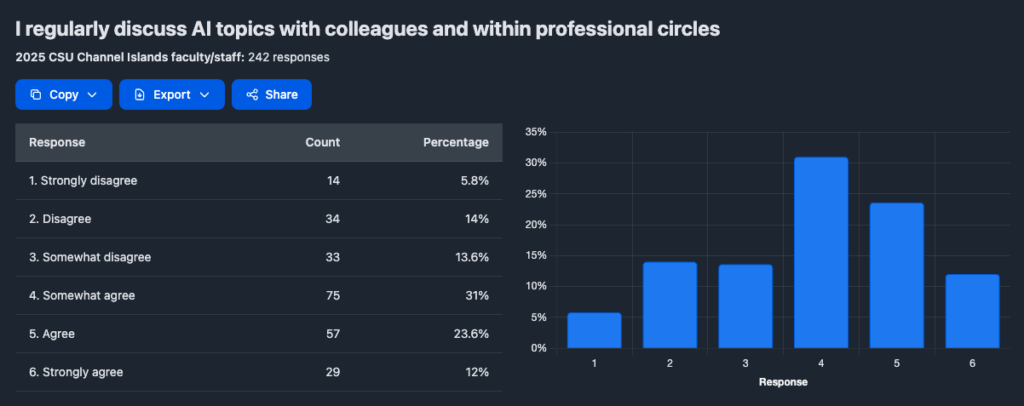
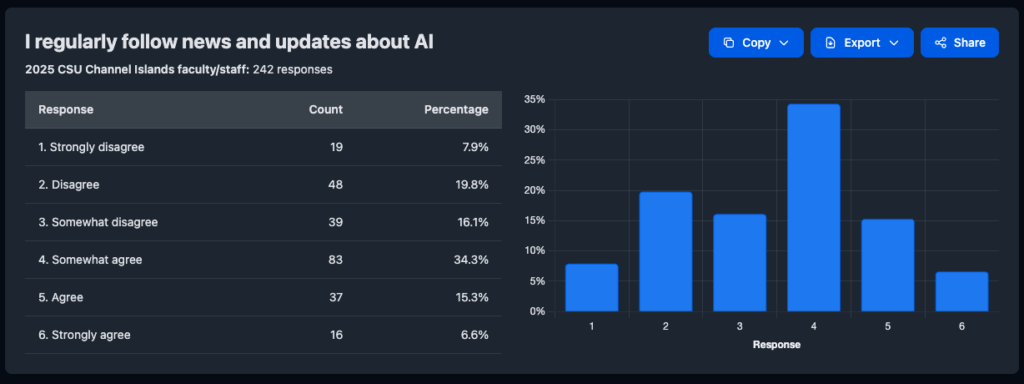
Based on these survey results, CSUCI staff appear to be actively informed and professionally engaged with AI. When asked whether they regularly discuss AI topics with colleagues, nearly 67% (n=161) agreed. Relatedly, 56% (n=136) agreed that they regularly follow news and updates about AI.
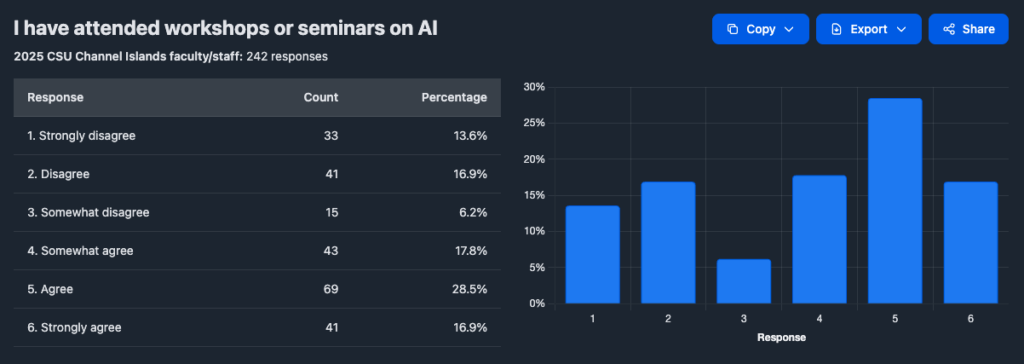
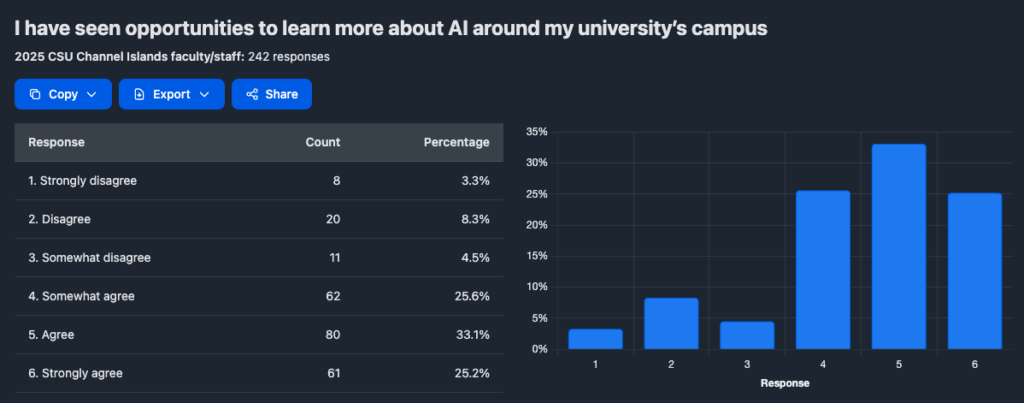
Notably, nearly two-thirds of CSUCI’s professional staff (63.2%; n=153) indicated that they have attended workshops or seminars on AI; and when asked whether they have seen opportunities to learn more about AI around campus, the response was even stronger, with 84% (n=203) of participants in agreement with that statement.
For Teaching and Learning Innovations, this is an encouraging sign and a meaningful level of voluntary participation in professional development. It raises questions about what is motivating this engagement (e.g., perceived need; genuine curiosity; application to job functions; supervisory influence, etc.). Our Summer AI Residency, for example, has been a rich space for open, critical discussion, diverse demonstrations, and timely updates. At an upcoming Extended University Lunch-and-Learn, we’re discussing the use of AI in email drafting at work. We’ve also seen strong attendance at ITS community of practice sessions and in unit-level opportunities. At both of the Academic Affairs Semester Kick-off events, AI-related sessions (e.g., AI Ethics Listening Sessions; Prompt Party, etc.) were standing room only. It’s our observation that employees at CSUCI are interested in this space, and that these interests include both critical examination and creative application.
We also noticed that these results contrast with student responses about their learning opportunities, and we wonder whether this might mean that students are receiving a different socio-cultural experience around AI at CSUCI.
Staff Report Positive Effects on Work
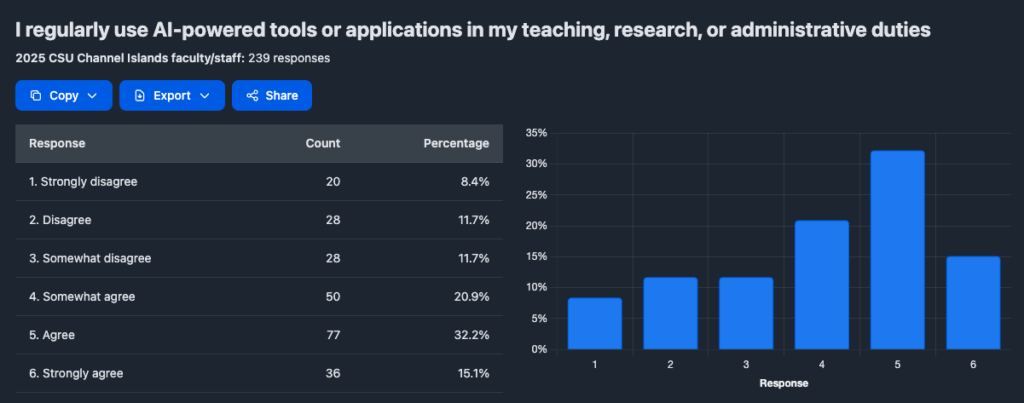
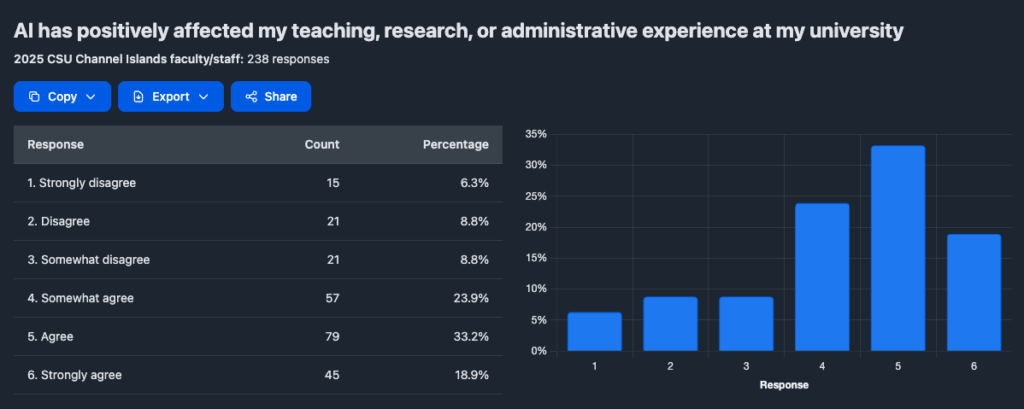
Given the level of engagement and professional development related to AI, CSUCI staff reported positive impacts to their work. When asked whether they regularly use AI-powered tools or applications in their teaching, research, or administrative duties (remember, staff and faculty received the same question set, even as some staff also do teach and do research), 68% (n=163) were on the agreement side of that scale. Further, 76% (n=181) of participants agreed that AI had positively affected their teaching, research, or administrative experience. For one thing, this slight difference across the two questions suggests that even some staff who do not use AI regularly (maybe they use it once in a while or have used it before) still saw positive benefits of AI in their work.
Speaking from my experiences with TLi, professional staff on our team have used AI for some of the following use cases (and more):
- Vibe coding accessible online materials in preparation for ADA Title II compliance
- Writing scripts to perform academic technology tasks (e.g., course copies and course merges—the AI does not perform the function, but the scripts are written with support from AI capabilities)
- Compiling research on learning frameworks
- Customizing rubric generators and course tuner assistants to support faculty in their course development processes
- Automating some of our internal records and reporting systems
- Customizing and developing prompt helpers for people to have more effective chats with AI tools
- Composing epic videos for Legends of Academia (this was a very involved creative process worth reading about!)
Elsewhere at CSUCI, there are impressive case studies of AI used with humans in the loop for improved processes (for a great one, see Extended University’s Mahibot and Coach Mahi applications).
These use cases (and the many more that are happening at CSUCI) augment the human skillsets but still require our professional staff’s expert knowledge in order to build them, as well as the soft skills needed to deploy and maintain them effectively. I could not, for example, create the videos that Isaac made for Legends of Academia. That work required domain knowledge and professional skills that extend far beyond AI prompting. As a CSUCI staff member, the ways that I use AI (when I use it) are specific to my context and needs, and effective use requires both my expertise, my own critical thinking, and my capacity to identify areas for further exploration and personal development.
Staff Are Not Embarrassed to Use AI
When asked whether they would feel embarrassed if someone found out that they used AI to help with a job-related task, about 73% (n=173) said that they would not. In total, only about 11% (n=26) agreed or strongly agreed that they would feel embarrassed about this.
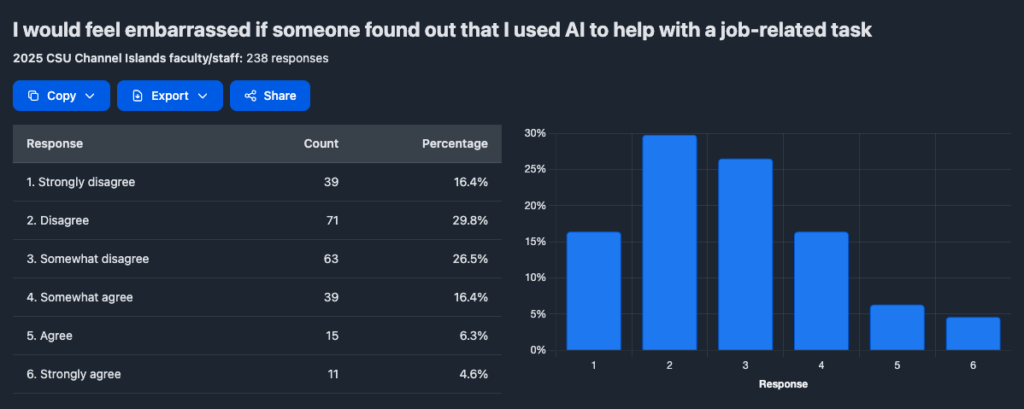
These results are another interesting contrast to the student findings, where more than half of the participants indicated that they would feel embarrassed if someone found out that they had used AI in their schoolwork. I think that staff may find themselves in a pragmatic place, where expectations and use cases (including when/how not to use it) are perhaps more clear.
Professional, Environmental, & Social Concerns
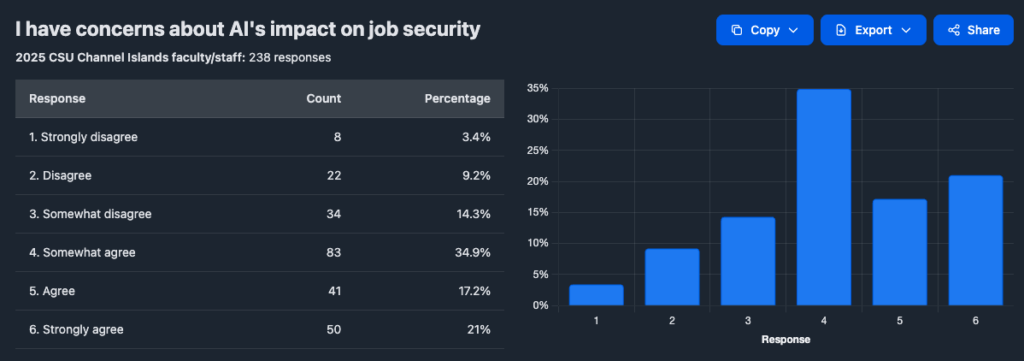
Although CSUCI staff report benefits and use cases in their work, and in our own experiences those benefits have been augmentative in nature, they also expressed serious concern about the stakes associated with AI diffusion. About 73% (n=174) of staff participants agreed that they have concerns about AI’s impact on job security. Given that CSUCI staff also report largely staying informed about AI in the news, this number is not surprising. It’s also not contradictory to our widespread use of AI. In other words, a person can find a tool genuinely valuable while also recognizing that its broader adoption will have consequences for the nature and landscape of our work. I’ve wondered quietly to myself whether I would even be qualified or competitive in the learning designer role I used to occupy at CSUCI, as I’ve witnessed it change over the past few years.
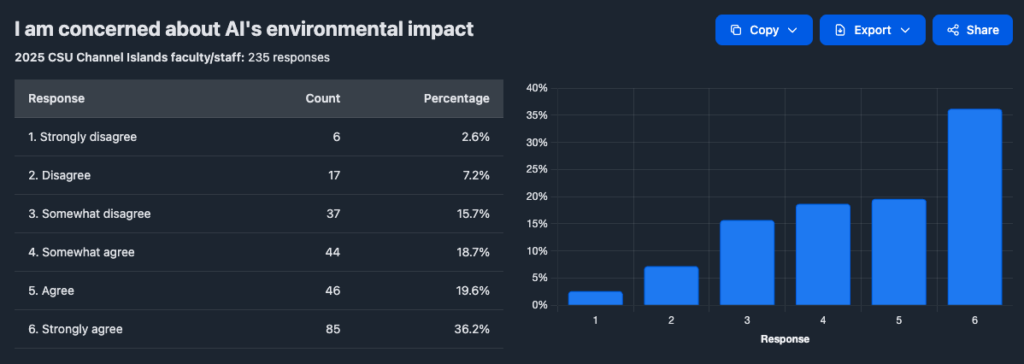
Like students, environmental concerns about AI were high for staff as well, with 75.5% (n=175) of CSUCI staff indicating agreement, including 36% (n=85) in strong agreement, with that statement. As mentioned in the post about student results, this point is worthy of discussion: What do we know about the environmental impacts, and how do we weigh any potential (or lived) benefits against the consequences? Are there environmentally conscious or responsible ways to use AI since it is so prevalent in our digital infrastructure? What is the role of our institution in navigating this ethical dilemma?
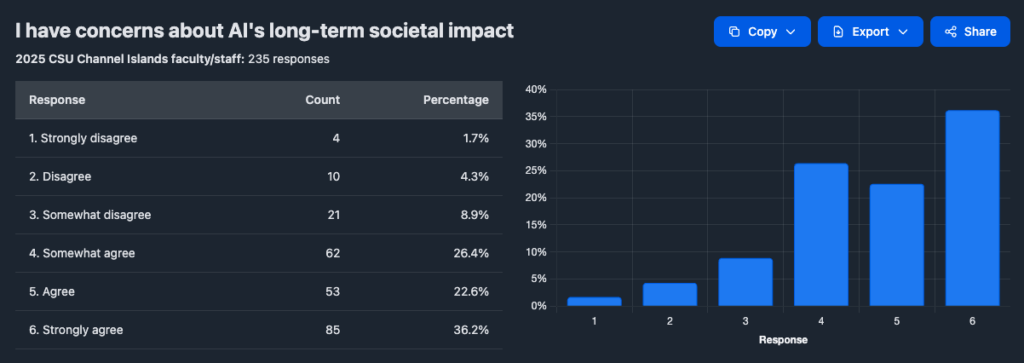
A staggering 85% (n=200) of the 235 CSUCI staff responses expressed concern about AI’s long-term societal impact. This is the highest level of consensus in the CSUCI staff dataset. The dashboard does not include open-ended, qualitative responses, so questions remain about what this datapoint means. I think that we have an opportunity to have important conversations about governance, ethics, sustainability, and workforce development, especially given how engaged we are as a professional community. Once again, I am encouraged by the work of the CSUCI AI Ethics Board, which includes representation from diverse roles, perspectives, and experiences, and whose charge includes examining ethical dilemmas through a structured framework and protocol coupled with research.
Closing Thoughts
When I started working for CSUCI in 2012, I remember driving onto campus and seeing banners that boasted CSUCI’s designation as one of the best places to work. Nearly 14 years later, I still feel that way when I get to work on interesting projects and collaborate with people who find creative ways to address complex challenges. Many CSUCI staff are professionals with advanced degrees and domain expertise. Many also see themselves as non-faculty educators because of their approach to work in higher education as an educational endeavor. Many are CSUCI graduates themselves and hold titles for jobs with widespread marketability: analysts, advisors, technicians, specialists, coordinators, project managers, directors, designers, etc. In the context of this AI survey and the CSUCI staff responses, it is interesting to note the tension around AI use and social stigma. In some academic settings, written assignments are often used to assess learning, and AI dramatically complicates that goal; and in some disciplines, writing is a vehicle for thinking, but AI shortcuts those cognitive processes. So, it may be a challenge for CSUCI, and higher education writ large, to navigate AI diffusion and shape the future. I’m biased, but I think that we have the right people with which to do it.
As mentioned previously, the entire AI Survey Dashboard is worth exploring for results across roles, campuses, and other demographics. We also continue to invite discussion about this work. If you find patterns in the survey and wish to draft a blog post, please connect with Teaching and Learning Innovations to pitch your idea.
