Last time we wrote about Mahi, “Meet Mahi“, we were introducing you to the persona “Mahi” (the helpful dolphin fish), as we launched Mahi-Bot to support students 24/7 through our web-based AI virtual assistant. Jump ahead to today: with two years of data, we have been listening to students through Mahi, AI SMS text messaging, and are ready to share a number of takeaways and outcomes.
What have we done since launch? Mahi-Bot continues to support students, helping us provide immediate response, answers, and resources, while making our team accountable for maintaining current and accurate website information for Extended University (EU). More recently, Mahi (using Edsights) has expanded with AI-text-based conversations, reaching out to undergraduate and graduate students about their sense of belonging, health and wellbeing, academic success, and financial support. To encourage engagement with Mahi, EU has produced video content for students to visually connect to the people behind Mahi and increase interactions with Mahi as a 24/7 support contact. This type of AI SMS text communication only happens with the integration of a robust knowledge base, as well as other tools for data validation, watching trends, and focusing on listening to the students. Behind Mahi, we have found that the key is the opportunity to include human connection alongside the technology.
How it Works
Mahi reaches out to students via text messaging upon the completion of an application to the EU program. Support is offered from the admission process through their enrollment (i.e., Edsights Admit), asking about fears of going back to school, financial concerns, sense of belonging, and personal wellness. Mahi continues to listen to students throughout their educational journey toward graduation, offering touch points to support student success (i.e., Edsights Retain).
Before the academic year, with the help of EdSights, our team maps out a full campaign calendar for each semester. This planning work is what keeps Mahi from feeling like a random check-in, with every message a student receives being intentionally designed and targeted for where they are in their academic journey.
Our campaigns fall into two categories. The first are standard EdSights pulse checks. These are platform-wide campaigns built around key indicators like temperature, belonging, wellness, persistence, and financial check-ins. These indicators provide consistent, comparable data across terms and help us track how students are feeling over time.
The second are custom campaigns we design specifically for targeted student populations. These campaigns reach where the standard pulse checks don’t, building off the feedback we receive from student responses. Custom campaigns like Admin & Tech Hurdles, Winter Break Basic Needs, and Spring Onboarding are built around the specific vulnerable points we know our online students face. This includes moments when a barrier is left unaddressed and can quietly derail their academic success.
Every campaign is built around five defining elements: the term it runs in, the audience it targets, the category it falls under, the key question(s) it asks, and whether a student’s response should trigger a follow-up from a specialist. The follow-up is intentional; not every message requires a phone call, but some responses signal that a student needs more than a standard response prepared by the knowledge base, and the system is designed to surface those.
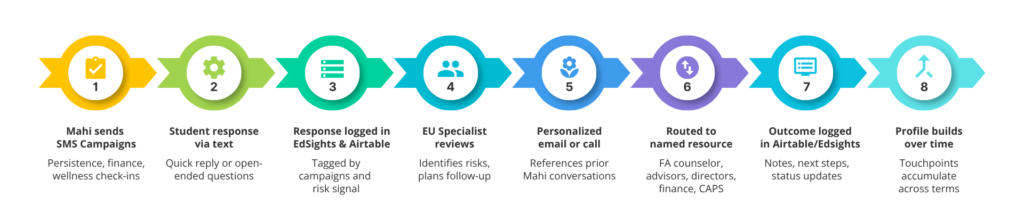
When a campaign goes out, Mahi sends a text and waits. When a student responds, that conversation is logged in the EdSights dashboard and Airtable, where the conversations become data. From here, we are able to monitor trends and track interventions. An EU Specialist reviews the response, assesses what the student needs, and provides context and care to that conversation. It gives our Specialist a full picture of a student’s history before they ever pick up the phone, and it gives our team the ability to watch common threads across campaigns, terms, and programs.
Numbers and Engagement
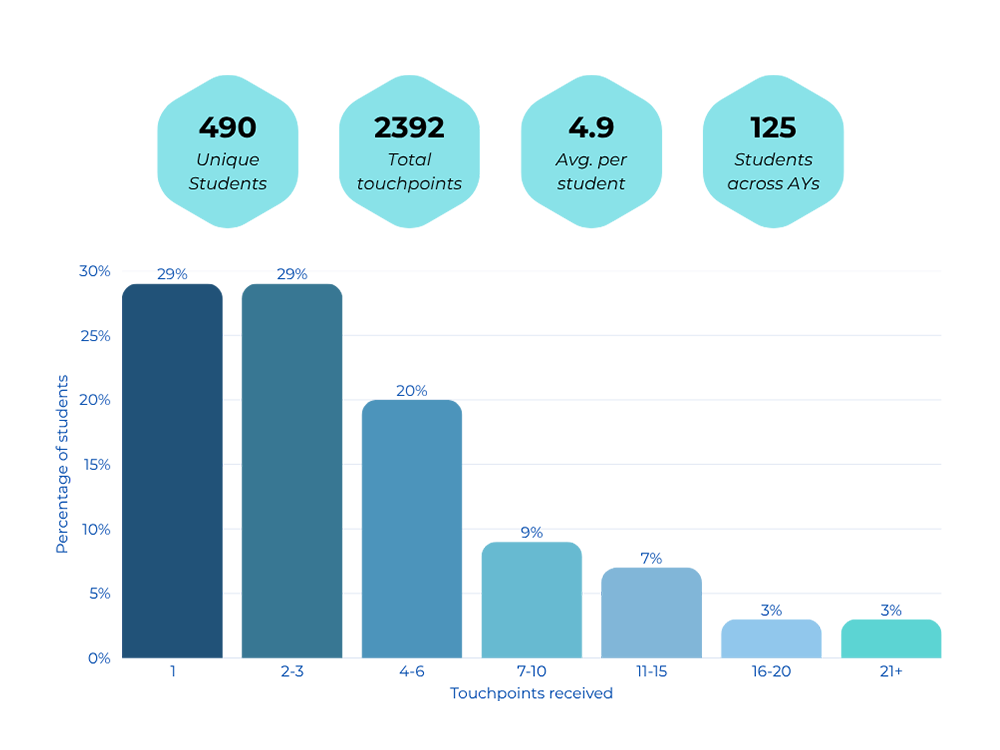
Outreach starts at application in Admit and follows students through graduation in Retain. Our Retain side (current student) is at 95% opt-in, 63% of students are actively engaging and texting Mahi back, totaling 2,637 student texts. Admit (i.e., prospective and admitted students) is at 96% opt-in with 622 inbound texts. The 37% engagement on the Admit side is expected, since it launched just this spring. More than 600 distinct students have interacted with these campaigns and texted Mahi back. Once students have started their first semester, they maneuver onto the Retain side, where we have recorded 2,392 retention indicators. This includes 490 unique student interactions, averaging 4.9 touchpoints per student, and 125 students engaged across both academic years. Of our total active student population, we have recorded a variation of response patterns: 29% one-time, 49% moderate (2-6 responses), and 22% deep (7+ responses), displaying sustained use and engagement with Mahi.
What Students Share
Communication with Mahi is not a one-way street. Mahi doesn’t just deliver messages. Mahi is listening to our students, and students are sharing! We have found that when students are given a low-stakes, easy way to respond, this can tell us more than most formal surveys ever could.
On the Admit side, campaigns focus on learning about the intent to attend, college motivation, sense of belonging, completing key steps for onboarding, and uncovering fears as they enter college at this level. These campaigns have helped us understand where prospective students are emotionally, not just logistically, in the application process. In relation to one of our intent campaigns, of the students who responded, 40 said they were definitely coming, 27 were still unsure, and 4 let us know they weren’t planning to enroll. Each of those “not sure yet” responses is a real person with a real barrier, and an impactful opportunity for our team to connect and remove it before it impacts their final decision.
When students respond within Retain, the themes that surface most are often related to finances and tuition concerns, the challenge of balancing work and school, academic uncertainty, mental health, and basic needs. These are not surprising topics in the higher education sector, especially serving a larger majority of first-generation and nontraditional college students. However, we have found that students are taking their power back by sharing their voice, even at times unprompted.
When our team connects with students, we have experienced and reflected on situations where our efforts are having a real impact on student success. Late one evening, a student in the BA Psychology completion program sent a text message to Mahi: “I am a mom who decided to go back to college. I wanna prove to myself and show to my kiddos that dreams don’t expire.”
She wasn’t given an application essay or question to share this response. Mahi gave her that opportunity to share on her own time, in this case at 9 pm, because it was a safe space to reply. That’s the kind of honest, unguarded response that only comes when the barrier to sharing is low, and the relationship feels real. Our priority is to make sure someone on our team hears it, acknowledges it, and shows up for her.
Building a Relationship
Most outreach systems begin at orientation and check back in closer to graduation. Everything before the program starts and in between, from financial-related panic, advising class schedules, and unexpected life events, may go unseen. By the time a student goes quiet and it’s noticed, the moment to intervene has often already passed.
Mahi was built to close that gap. By the time an admitted student transitions into an active student, they have already had multiple points of contact with Mahi. They’ve answered questions about their sense of belonging, their motivations, and their fears. And that history doesn’t disappear, it travels with them, so we are always ready with context to best support.
What makes this meaningful isn’t just the technology. It’s the people behind Mahi. Every student response that surfaces a concern gets reviewed by the EU Specialist, who provides context and care to that conversation. They know which students have been struggling for months and which ones are flagging something new. They are the one who picks up the phone, send the follow-up email, and make the connection to the right campus resource. Mahi opens the door for conversation, and our EU Specialist is there ready to support. AI responsiveness with the human in the loop.
Even in the use of Admit, where we are still in early stages with 129 students, 234 touchpoints, and 37% engagement, those numbers matter more than they appear because the student-Mahi-EU relationship has already begun. A relationship that starts before enrollment is one that doesn’t have to be built from scratch in the second or third week of the semester. That earlier connection can be hard to grasp the significance of, but anyone who understands student success in higher education or has been a student can relate to the value.
What’s Next?
The numbers tell us students are opting in and engaging with Mahi, but the human outreach tells us students are appreciating the individualized follow-up. When our EU Specialist connects after Mahi flags a need for intervention, students are receptive with an overwhelmingly positive and grateful attitude. They often share more about what’s going on to be connected to resources, ask additional questions, and share words of thanks for the personal follow-up. The tone of these exchanges is the part we wish we could quantify. What’s harder to measure is whether students use the resources shared to confirm they received the support needed for success. However, student retention data and the student voice score have been positively telling some of the story of achievement in this area. Our next potential developments include “Mahi Mentor” and the exploration of utilizing Mahi as a support for academic advising and study skills coworker as a crucial next addition to our Mahi Suite: Mahi via EdSights, Mahi-Bot (virtual AI chat), and Coach Mahi (career coach bot) via Playlab, to provide the comprehensive wraparound support for our students.
In both spaces where Mahi gets input from students, Admit and Retain, we are seeing students opt in with consistent responsiveness to text campaigns. Our students (and we!) have found a space to communicate what they need for success, and our role is to keep listening.
