In Fall semester 2025, CSU Channel Islands participated in a systemwide AI perception and usage survey designed by researchers at San Diego State University. Remarkably, over 2,000 CSUCI students responded to the survey (CSUCI had similarly strong participation rates among faculty and staff). The full AI Survey Dashboard, with results from all participating campuses, can be filtered by role (e.g., student, staff, faculty), academic program, specific CSU, etc., and while it does not currently include the qualitative responses, there are plenty of opportunities to draw insights from the available dashboard views. Teaching and Learning Innovations reviewed the results for themes related to teaching, learning, and trust, and we triangulated these responses with some of the feedback we have collected over the past year in the Student AI Listening Session (Summer 2025), AI Ethics Board Listening Sessions (Fall 2025 & Spring 2026), and other avenues (e.g., ASG Resolution; Student AI Ambassadors/Panel). We share some of those insights and resources in this blog post.
A Quick Note
The items in the AI Survey are perception-based and reported on a six-point agreement scale (strongly disagree→strongly agree). The responses are useful for identifying patterns, tensions, and signals to pay attention to. They tell us generally, in Fall 2025, where our students felt confident, uncertain, supported, or concerned. The results are not a measurement or indicator of classroom practice or instructional quality. They don’t tell us what happens in every course; and though AI technologies and capabilities continue to rapidly evolve, the survey results also don’t reflect changes that may have already occurred since Fall 2025.
For this post, we focused on nine of the thirty-four Likert-style questions on the dashboard, and we focused our examination on student participants from CSUCI only. Though we report on the results and link to filtered datasets for review, the insights and opinions are our own based on our involvement with AI at CSUCI over the past three years (some of which is captured on the AI at CI webpage and others published on the TLi Blog).
Few Students Follow AI Updates, But They Are Talking About AI
When asked whether they regularly follow news and updates about AI, about 61% (n=1,377) disagreed. However, the responses were nearly evenly split when asked whether they discuss AI topics with friends, family, or classmates, with just over half of the student participants (about 51%; n=1,133) landing on the agreement side.
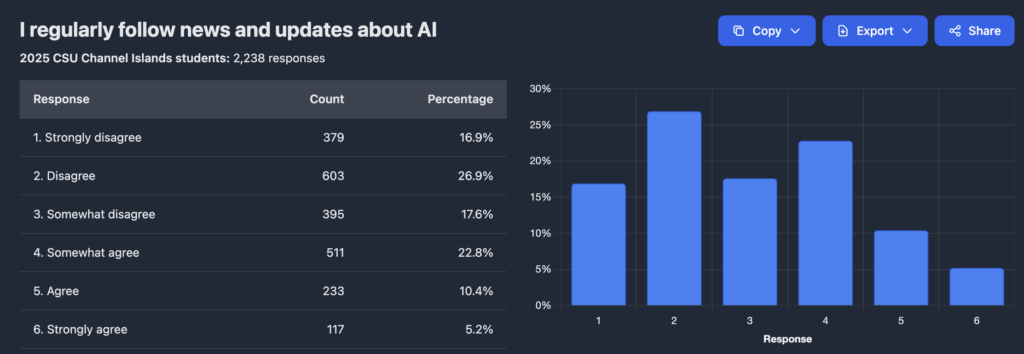
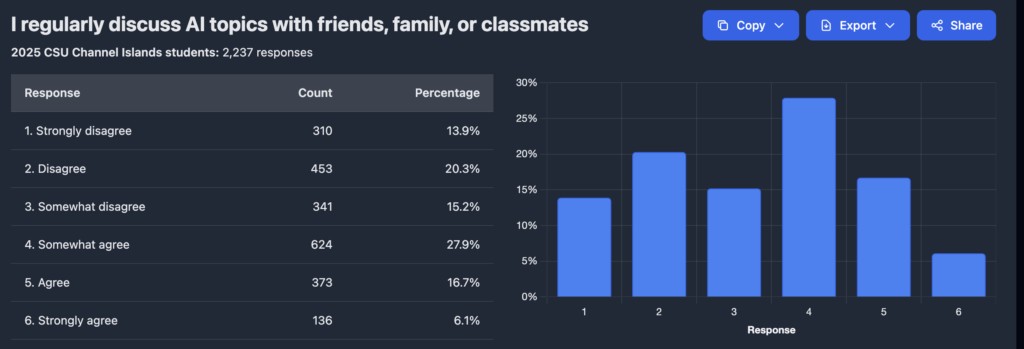
We find this gap between information consumption and active conversation to be interesting, particularly as AI features continue to emerge in their digital lives (e.g., Google searches; academic experiences, the larger cultural and political moment, etc.). There is opportunity, here, to become informed consumers and even shape the change. CSUCI’s Student AI Ambassadors, Daniel Orona and Isaac Lares, are doing just that by holding student workshops for their peers, while grad student and AI researcher, Nicholas Bridgman writes and publishes an AI newsletter for the CSUCI community.
Students Report Benefits in Learning, But Also Want Guidance
In 2024, CSUCI’s Associated Student Government published a Resolution in Support of Responsible AI Use & Campuswide AI Usage Guidelines for Course Related Work. This resolution argues that institutional guidance would help students use AI appropriately without fear of violating academic integrity and that it would improve transparency and responsible use at CSUCI. This sentiment is echoed resonantly in the survey results a year later, with 64.6% (n=1,414) agreement that “AI has positively affected my learning experience at my university,” but only 36.1% (n=755) agreement with the statement, “My professors teach me how to use AI effectively.” From a teaching and learning perspective, this gap suggests that students are finding informal benefits from their use of AI (e.g., for fun, and following Breeann Austin’s post on Consensus, here is a Consensus Pro thread on accessibility) but that they would benefit from more structured, discipline-relevant guidance within their courses.
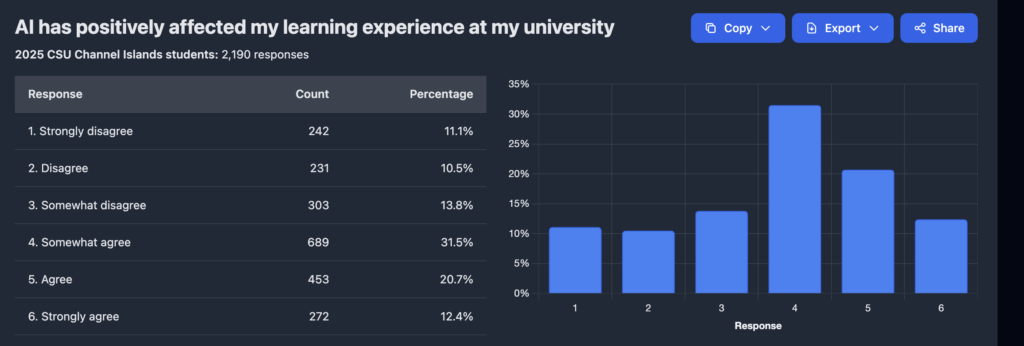
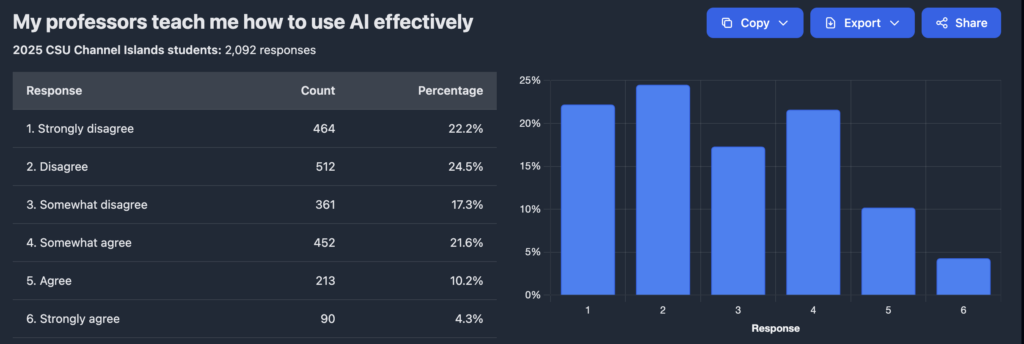
Fortunately, many CSUCI faculty are deliberate and engaged with these concerns. TLi’s Legends of Academia program includes many customizable templates for communicating expectations, modeling practices, etc., and these templates are available on Canvas Commons for anyone to import into their courses (in Canvas, navigate to Commons and search “Legends of Academia”). Further, our Spring 2026 Faculty Inquiry Communities included two spaces for approaching these issues. One community is fostering rich discussion about empowering students not to use AI in humanities and creative works, while another is “decoding” disciplines for tacit practices associated with AI. We also have Digital Learning Mentors who offer their skills, knowledge, and experiences with AI to their faculty peers.
AI Use is Common, But the Stigma is Real (if not Universal)
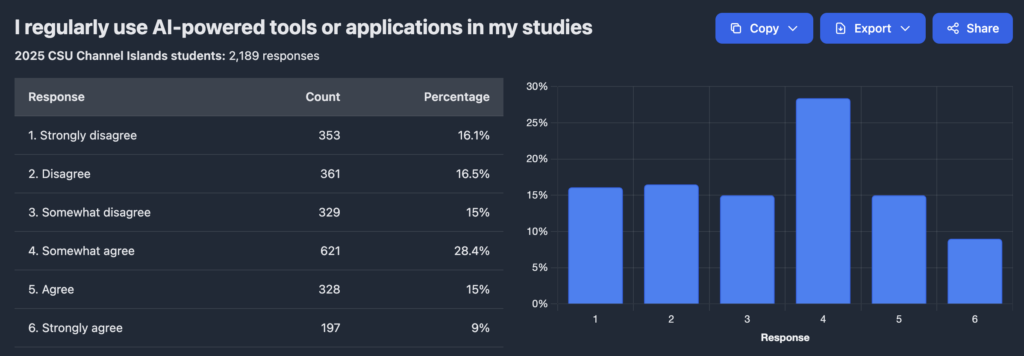
A slight majority of students who participated in this survey (about 52%; n=1,146) reported that they regularly use AI tools or features in their studies. This is actually a significant uptick in just over a year’s time. In Spring 2024, the data trended in the opposite direction, with about 52% of respondents on that Student AI survey indicating that they had never or only once used AI in their coursework.
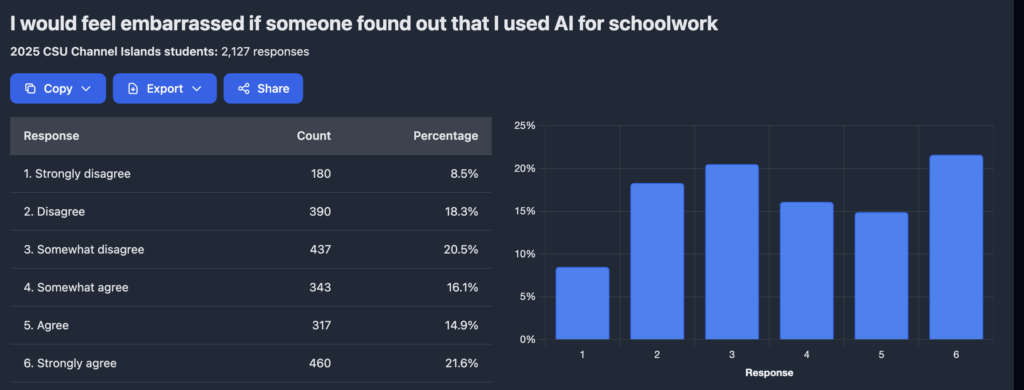
Though we are seeing more opportunities for AI use in coursework, and more students are reporting that they use it, one of the more striking findings (perhaps also most actionable) involved the social dimension of AI use. Students were asked whether they would feel embarrassed if someone found out that they had used AI for coursework. Responses clustered at both ends of the Likert scale: About 47% (n=1,007) of students fell on the disagreement side (i.e., they would not feel embarrassed), while about 53% (n=1,120) fell on the agreement side, including 21.6% (n=460) who strongly agreed that they would feel embarrassed if someone found out that they had used AI for schoolwork. That is more than one in five students who would strongly feel shame about their AI use being discovered.
I think that these points matter. CSUCI student usage of AI tools for their studies has increased, and they report perceived benefits in their learning, but they are not reporting as much widespread guidance as they would like to see in their courses. From a TLi perspective, this makes us think about the learning environment as a community of inquiry. If students feel that they must hide how they are working, then they cannot ask questions, get guidance, or develop effective practice related to these tools. There is an opportunity to talk with professional and academic colleagues about their approaches to AI in academia, communicate with transparency about expectations (e.g., for use, citation, etc.), and also model appropriate and effective practice (even if the practice is not using AI).
Skepticism and Concern
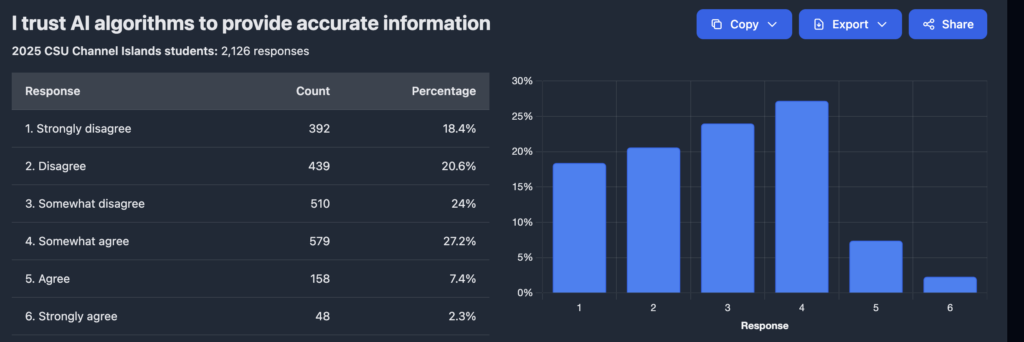
Nearly two-thirds of student participants (about 63%; n=1,341) indicated that they do not trust AI algorithms to provide accurate information (only 10% of respondents agreed that they do trust AI). From our review of the survey results, this question showed one of the strongest points of consensus among participants. Given the growing concerns from faculty about the impacts of AI on cognition and critical thinking, this skepticism is encouraging from a critical thinking standpoint. We’ve heard this perspective elaborated in student panels, like at the Spring 2026 Division of Academic Affairs Kick-off in January, where students shared incredibly thoughtful and deliberate ways that they were using AI, but also verifying outputs or using chats in conversation with other academic materials, for example. They shared how they use AI to generate study questions and organize their notes. One generously shared how AI helps him manage his ADHD by shifting his attention to on-topic details and side quests, rather than veering off from his study to other things that grab his attention.
Other areas of strong agreement were also related to student concerns about environmental impacts and ethical uses of AI. Nearly 80% (n= 1,639) of students expressed concern about the environmental impacts of AI, with 42.9% (the largest single response category across all questions) selecting “strongly agree.”
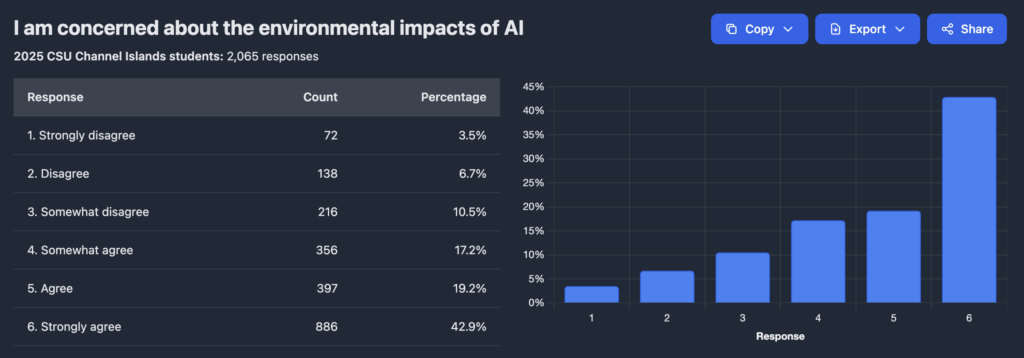
CSU Channel Islands is known for our sustainability commitments and values, so it is important for us to educate ourselves and make informed decisions. Water use, energy consumption, and carbon impacts of LLM development and deployment are sustainability issues worth exploring. They raise questions also worth discussing with students: How (if at all) do we weigh potential benefits against these costs? What does responsible use look like in the context of genuine environmental concerns?
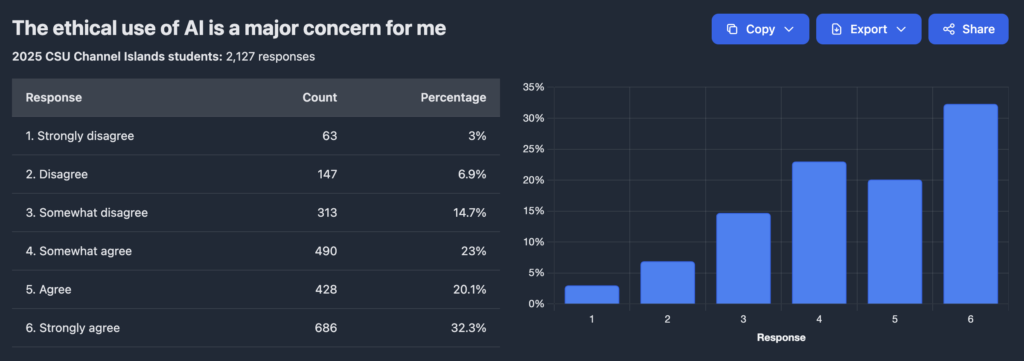
At the time of the AI Survey, ethical concerns were also top of mind. In the CSUCI student dataset, 75.4% (n=1,604; that’s 3 in 4 students) agreed that the ethical use of AI was a major concern. Though this survey dashboard did not report open-ended qualitative responses, similar concerns emerged from CSUCI’s internal Spring 2024 Student AI survey, in which students shared concerns about faculty using AI to grade their work, impacts of AI on the value of their degree, what happens when students who use AI are rewarded when those who did not are penalized in terms of their perceived performance and grade marks, and what ethical obligations we have to leverage AI as an enabling technology for students with disabilities or learning differences.
At CSUCI, we are fortunate to have an AI Ethics Board with student, faculty, and staff representation, as well as a structured protocol for unpacking ethical dilemmas, scanning available research, and drafting ethical guidance in the form of white papers and listening sessions across campus.
Closing Thoughts
The entire AI Survey Dashboard is worth combing through. It can present results for other CSUCI participants (e.g., faculty, staff), compare responses across groups, and show results in context with the rest of the CSU. For this post, we focused on results from CSUCI students and those that stood out to us with implications for teaching, learning, and community/trust. At the time of this writing, we are seeing consistency between the results for our campus and national reporting, like this study about how Gen Z is using AI. I think we can see value in shared language and consistent expectations, even if those things look different in different classes or programs. Some final recommendations that we will take with us into our work include the following:
- Make space to discuss and educate ourselves about AI, particularly as it continues to evolve.
- Name expectations (e.g., in the syllabus, assignment instructions, community agreements, etc.).
- Teach appropriate use and/or resistance.
- Align learning activities and assessments with clear objectives and learning outcomes.
Finally, we invite continued discussion about this work. If you find patterns in the survey and wish to draft a blog post, please connect with Teaching and Learning Innovations to pitch your idea.
