This post concludes a 3-part series that drew teaching and learning insights from the Fall 2025 CSU Systemwide AI Survey led by SDSU. The first post reviewed selected responses from the student survey, and the second post reviewed selected responses from professional staff participants. Participation rates neared 50% for each of these groups, individually, and for CSUCI overall.
If you’ve read the headlines about AI in higher education over the past three years, then you may have witnessed the hysteria pitting students and educators against each other on the topic. Between concerns about AI-generated course materials and grading, and AI-generated assignment submissions, it’s easy to miss (or misunderstand) the complexity of this moment. In my own field of composition and rhetoric, there is hot disagreement about whether academic freedom means that an entire field has the right to refuse AI or require it in their teaching. As I reviewed the data from the Fall 2025 CSU Systemwide AI Survey, a much more nuanced picture emerged—one where CSUCI faculty are learning, talking, and exploring AI, but also stewarding the educational experience with values, intention, and care (yes, I used an em-dash, but no, I did not use AI).
This post concludes a 3-part series on the Fall 2025 CSU Systemwide AI Survey, and focuses on faculty/instructor responses. More than 200 participants, representing close to 50% of CSUCI faculty, indicated a “faculty” role when they took the survey. Faculty and staff participants received the same question set, so screenshots included in this post will have “Faculty/Staff” labels, but the dataset was filtered by role to select only for those responses that were submitted by faculty participants. This post includes direct links to the filtered datasets, but you can also access them by navigating to the survey dashboard, filtering the dataset to select “2025 CSU Channel Islands faculty/staff,” then scrolling to the bottom of the page and filtering the role for “faculty.” Participants in this group received 38 statements with a six-point, Likert-style agreement scale (strongly disagree→strongly agree), and the SDSU-hosted survey dashboard does not include the open-ended, qualitative responses.
I also acknowledge a couple of things: This is a blog post, not an institutional report, so the insights and discussion are coming from the perspective of people who have been teaching & learning-focused and have been involved in campuswide leadership efforts related to AI diffusion and the CSU Systemwide GenAI strategy. I am both a staff member and adjunct faculty, and I carry that positionality into my reading of the survey.
For this post, we focused on 19 questions from the faculty dataset. This is more than we used for the student and staff-focused posts because we included the questions about the extent to which and ways that faculty were addressing AI in the classroom at the time. Because of the large question set, this post will only include select screenshots for illustration but will link to all referenced datasets in the body of the post.
Faculty Are Engaged & Learning
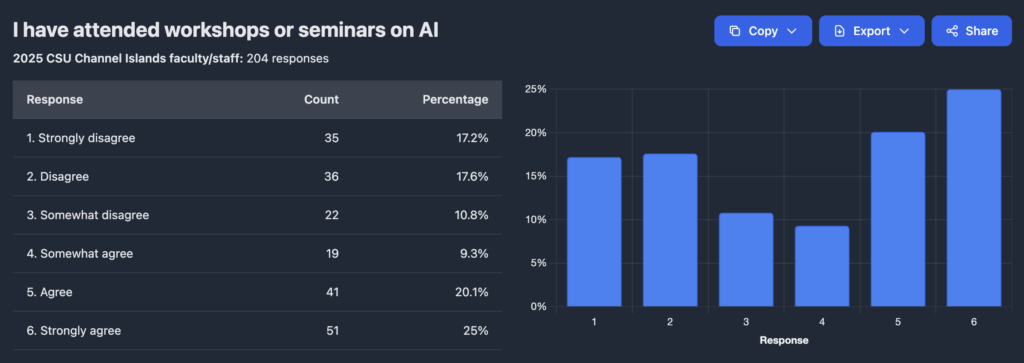
Several responses point to the idea that faculty are doing substantial sensemaking on their own about AI. When asked whether they regularly follow the news and updates about AI, about three-quarters (76.4%; n=156) of faculty participants indicated agreement. Similarly, 79% (n=161) agreed that they regularly discuss AI topics with colleagues and within professional circles. About 70% (n=135) indicated that they are actively seeking opportunities to learn more about AI, and 81% (n=165) said that they had seen opportunities to learn more about AI on campus, but roughly 55% (n=111) indicated that they had attended workshops or seminars on this topic. The bimodal result for workshop attendance is an interesting result, suggesting a sizable group that has pursued formal professional development alongside another sizable group that hasn’t found the right opportunity for their interests or circumstances.
Faculty Distinguish Between Personal/Professional & Pedagogical Use
There is nuance in the data around faculty’s reported orientation toward AI. The data suggests that they are engaging with it personally before bringing it into professional or classroom practice. About 69% (n=138) of faculty participants said that they use AI outside of work. Slightly fewer (63%; n=125) indicated that they regularly use AI in their teaching, research, or administrative duties.
Many report their experience of AI as both useful and disruptive: About 61% (n=120) agreed that AI has positively affected their teaching, research, or administrative experience; yet, 52.3% (n=93) agreed that AI had also negatively impacted that experience. These findings resonate with the messages in wider discourse, where it is entirely possible for AI to have made some parts of a person’s work easier while making other parts harder or more fraught. Both truths can exist at the same time (I’ve experienced this myself: I used AI to design rubrics and to create alternative formats for some of my instructional materials in the interest of accessibility, improving an administrative aspect of my teaching job, but AI also complicated ways I’d originally planned to assess learning).
In the Classroom: A Wide Range of Approaches
Perhaps the most varied picture in the entire survey was in the ways that faculty described their classroom policies on AI use. No single approach stood out among the options.
Course Policy on Students’ Use of AI
- n=182
- 6.6% indicated that they do not address AI with students
- 11.5% indicated that they forbid AI use
- 22.5% indicated that they discourage AI use, but do not forbid it
- 33% indicated that they acknowledge AI, but remain neutral on whether students use it
- 20.9% indicated that they encourage AI use, although it is not required
- 5.5% indicated that they require AI use in their course
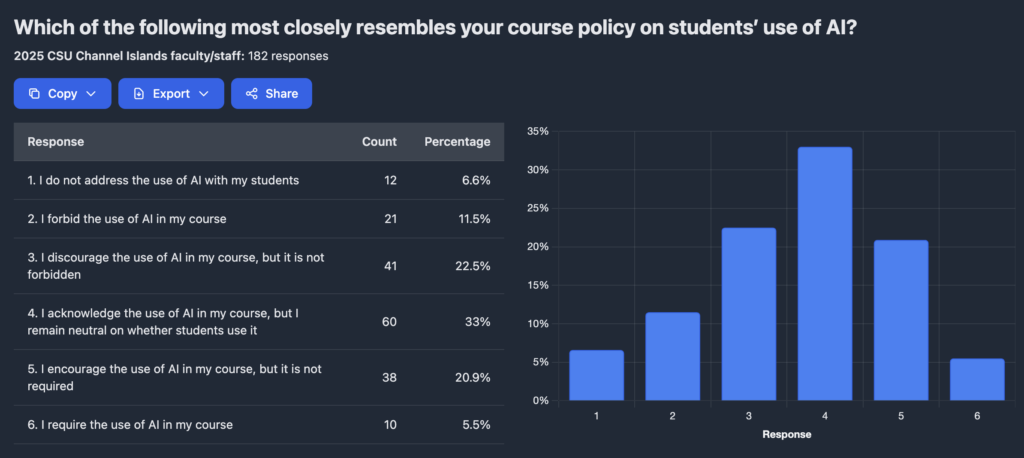
The largest single group (one-third of faculty participants) took a neutral stance, neither encouraging or discouraging AI use. It’s also encouraging that about 81% (n=147) of faculty participants indicated that they do not use AI detectors to evaluate student work, especially has that practice has been repeatedly shown to be unreliable and prone to false positives, with research and reporting that highlights risks of misidentifying human writing, disproportionately flagging certain student populations, and creating unnecessary academic integrity concerns that undermine the student-faculty relationship.
Additionally, just as faculty reported engagement and learning about AI for professional or personal purposes, 44.8% (n=82) said that they do not use AI to develop course materials, and only a relatively small response group (10%; n=19) indicated that they use it for most or nearly all materials. Similar to staff responses (and in contrast to students), a majority of faculty (72.3%; n=141) indicated that they would not feel embarrassed if someone found out that they used AI to help with a job-related task.
Despite these findings on course policies and production, 65.2% (n=118) indicated that their syllabi include an explicit AI statement, and 70.3% (n=135) agreed that they provide specific guidance to students on how to use AI tools effectively. This point is in contrast to findings from the student survey conducted during the same period, in which 64% (n=1,339) of student participants indicated that their professors do not provide that guidance.
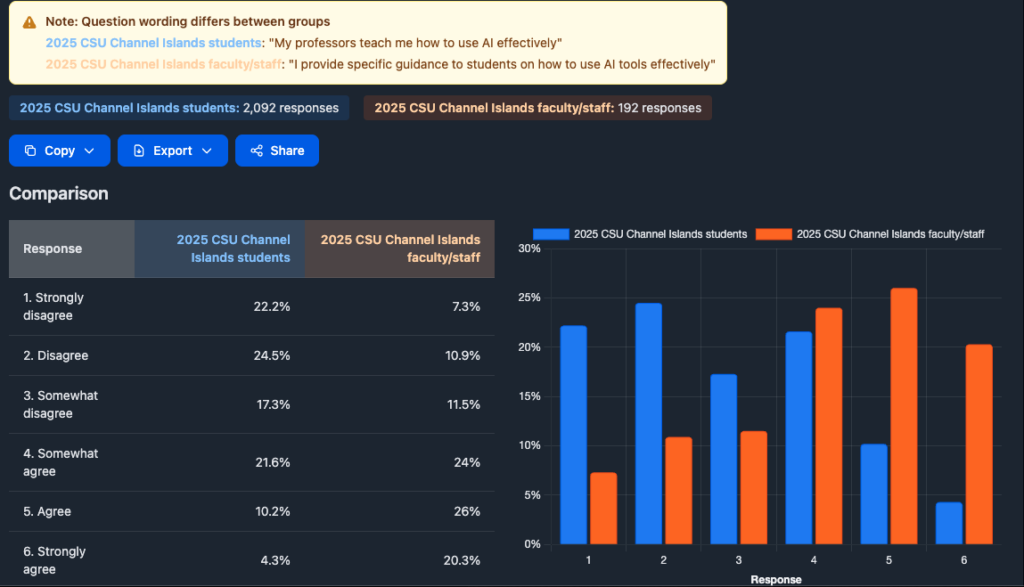
This finding only invites curiosity, including how participants across roles were thinking about guidance. For example, an instructor who includes an AI statement in their syllabus may reasonably feel that they have provided guidance, while a student encountering that same statement may not consider it to be instruction on effective use. Still, this gap does suggest that there is room for conversation about what guidance might entail in the context of an academic class, and what faculty and students each need from that exchange.
Dominant Ethical Concerns
Across all participant groups, ethical concerns about AI did show strong consensus, and that sentiment is reinforced in the faculty responses as well. When asked whether the ethical use of AI is a major concern, 88% (n=171) agreed, including 52.3% who selected “strongly agree.” This was the single most decisive response in the faculty survey. Concern about AI’s long-term societal impact was also strong: 88% (n=171) agreed, with 50% indicating strong agreement. Concern about AI’s environmental impact (a high point of concern for both students and staff, as well) registered at 81% (n=158), with 51% indicating strong agreement.
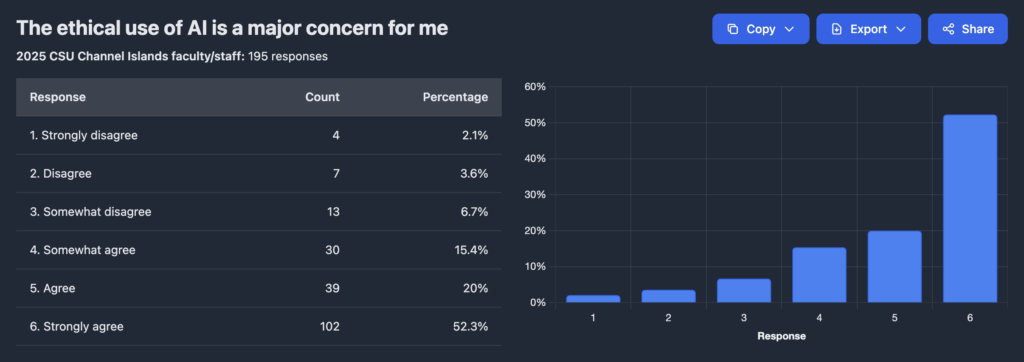
These strong concerns about ethics and impacts resonate across all response groups in this survey, including among those who also indicated that they use AI and that they have derived benefits from it. Use and concern coexist here. It’s reminiscent of CSUCI’s AI Basecamp in Fall 2024. Upon registration, people were asked to share two words to describe how they felt about AI at that time (note: it had been just under two years since OpenAI had launched ChatGPT). The responses even then reflected the sentiment we see now in this survey: curious and cautious; excited and skeptical; learning and concerned.
Closing Thoughts
These survey results tell a nuanced story about AI diffusion in higher education, and at CSUCI, specifically. I don’t see a narrative of pure resistance to emerging technologies, nor do I see uncritical adoption (both narratives you might find if you scroll social media). CSUCI faculty are reckoning with a complex paradigm shift, and they report that they are following the news, talking with colleagues, trying things out for their own use cases, drafting class policies, and grappling with ethical concerns. I see a transition in usage that moves from personal to professional, then from professional to pedagogical; and to me, that reads like the care I have seen faculty demonstrate here at CSUCI.
From a teaching and learning perspective, it is encouraging to see in these survey results that many faculty participants are providing guidance, including statements in their syllabi, choosing intentional course policies around AI, and, in some cases, encouraging responsible use. If you are a faculty member reading this blog and interested in knowing what kinds of support and communities are available at CSUCI, here are a couple of resources and opportunities:
- You are invited to participate in TLi’s upcoming Summer AI Residency (watch the DAA Newsletter for registration information)
- You can speak with someone on the TLi team about Legends of Academia (and watch for upcoming opportunities)
- You can join or follow CSUCI’s AI Ethics Board (white papers on AI Ethics topics are published periodically, and listening sessions are held at DAA events)
- Broome Library hosts useful LibGuides on AI
- WMC has resources for students and faculty
- TLi resource: Better Assignments in the Age of AI
- TLi Resource: Prompt-Helper Bot (for helping people write better prompts that improve AI outputs and reduce wasted queries)
- TLi Resource: CourseTuner (supports learning outcome alignment and course development)
- TLi has an inventory page of AI@CSUCI; ITS has another resource at Artificial Intelligence at CI
As before, the entire CSU AI Survey Dashboard is hosted by SDSU and can be filtered for multiple layers of analysis. If you see something of interest and would like to write about it, please reach out to Teaching & Learning Innovations to pitch your idea.
