Last semester’s ChatGPT and research blog series explored ChatGPT being used in the research process, with the advice that even with best practices, it should only be used in the exploration or brainstorming stage.
However, not all generative-AI (GenAI) tools function in the same way. Some are designed specifically to support academic research.
This post introduces Consensus Pro.
Why Focus on Consensus?
There are similar tools available, such as Elicit and Scite. However, I am highlighting Consensus because Broome Library has arranged free access to Consensus Pro for anyone using a CI email account.
What Is Consensus?
Consensus describes itself as:
“An AI-powered academic search engine built on a database of over 220 million peer-reviewed research papers. Unlike general AI tools, every response is tied back to a real research paper and is grounded in scientific research. It helps you quickly review the literature and understand complex topics faster.” (Consensus)
I describe Consensus as a Gen-AI merger between Google Scholar and ChatGPT. Like all research tools, it has strengths and limitations. Its value depends on how it’s used, and highlighting the differences between ChatGPT and Consensus also helps students understand ChatGPT’s limitations.
At its core, Consensus allows users to ask research questions in natural language. It then:
- Searches millions of peer-reviewed research papers
- Provides a one-sentence summary answer
- Generates a longer AI overview with scholarly citations
- Lists the academic sources cited in that overview
- Suggests follow-up research questions
Consensus Thread Example
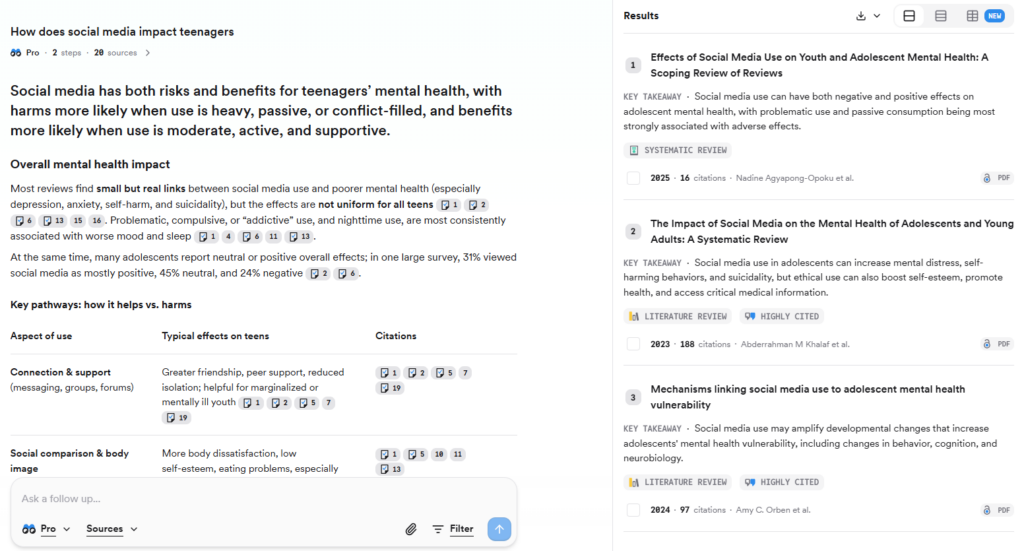
This alone would make Consensus useful.
The ability to ask questions in natural language (typing a question how you’d normally speak) helps students struggling with search terms, and hallucinations are minimized because Consensus draws specifically from scholarly publications (via Semantic Scholar).
Also, the cited sources and suggested follow-up questions encourage students to move beyond the AI-generated overview and engage with the scholarship itself. While students must still choose to investigate those sources, the design of the tool promotes exploration and accountability more effectively than general-purpose AI tools.
However, my favorite feature from Consensus is its Consensus Meter.
The Consensus Meter
When teaching information literacy, I emphasize two core ideas:
- How you ask a question matters. Leading questions can reinforce confirmation bias and spread misinformation.
- Scholarship is a conversation. Academic debates often include multiple interpretations and conflicting findings.
The Consensus Meter supports both ideas.
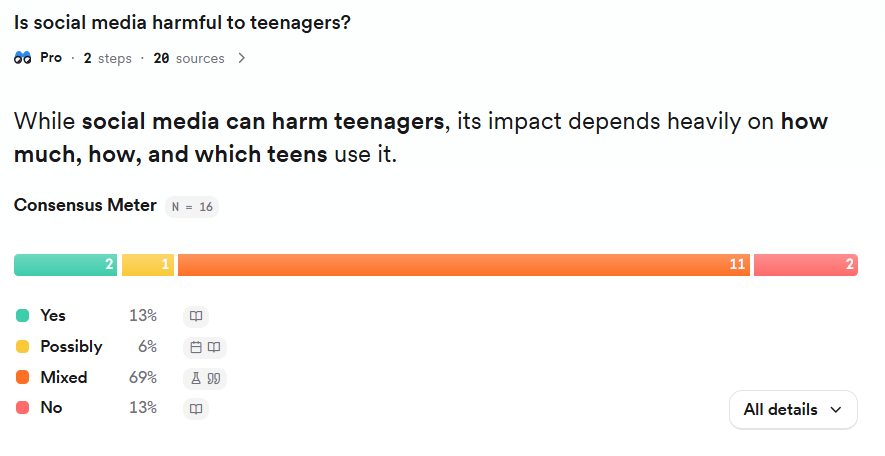
When users ask a yes-or-no question, the Consensus analyzes the approximately 20 relevant sources it lists and visually displays how many of the sources would answer “yes,” “no,” “possibly,” or “mixed”. The listed sources are also color-coded to reflect their position.
This visualization makes scholarly debate visible. It demonstrates that research rarely produces simple answers, challenges students’ assumptions, and naturally prompts follow-up questions to encourage further investigation of the sources.
Consensus Meter Example
Limitations
Consensus is not perfect.
In my own testing, it has linked to publications that were not peer-reviewed. The company also acknowledges an approximate 10% error rate in how sources are classified within the Consensus Meter. As always, students must locate and read the full text of articles and evaluate the research independently.
Additionally, like Google Scholar, PDF links may lead to publisher paywalls. But no one should ever pay to access these publications; search for the publication in Broome Library. If we do not own it, you can submit an interlibrary loan request.
Last Thoughts
In short, Consensus is a GenAI tool that can help students at the beginning of the research process when they don’t know what search terms to search in a library database, and its Consensus Meter helps visualize and prompt students to ask more questions.
However, while GenAI tools can support the research process, they do not replace critical thinking, scholarly reading, or the library. They are tools to facilitate, not replace, the research process.
