Disability does not always look the way people expect.
Some people use mobility aids. Others don’t. Some disabilities are visible, and many are not. This simple truth sits at the heart of why inclusive design matters so deeply, especially in higher education.
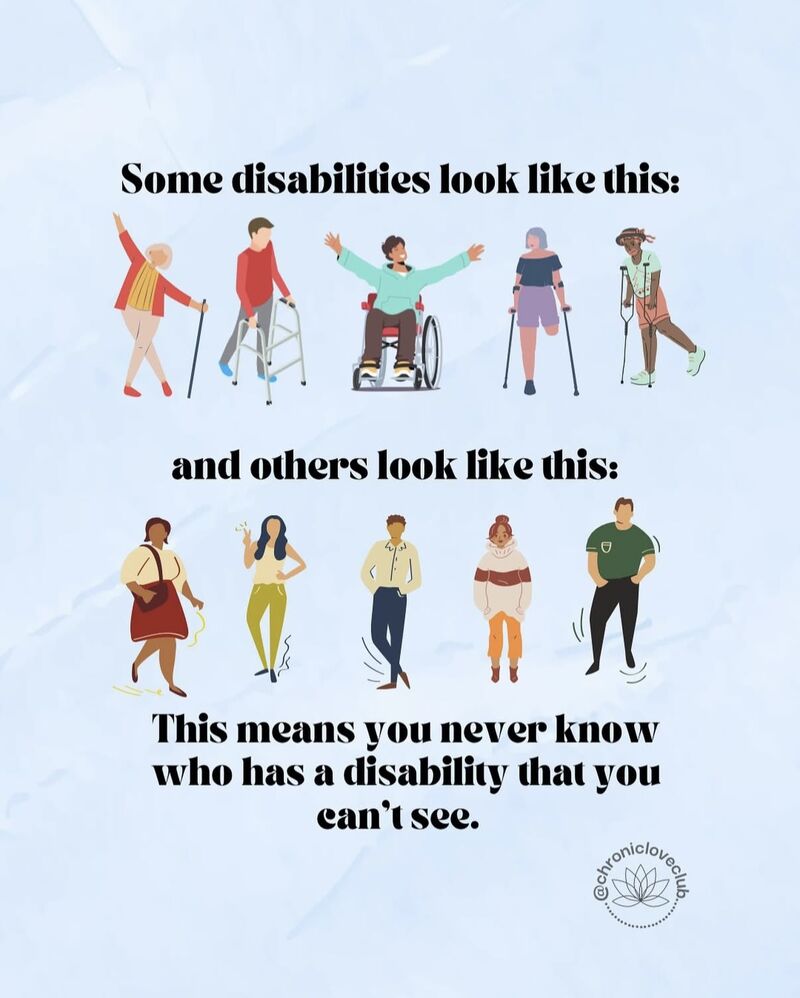
The image above reminds us of something easy to forget in busy classrooms, common areas, and online spaces: you cannot tell who is disabled just by looking at them. For example, the student sitting quietly in the back row, the colleague who always turns their camera off, or the person who never speaks up in large group discussions. They may look “fine,” but their lived experience could tell a very different story.
The Problem with Assumptions
Assumptions can be harmful, even when they’re unintentional. When we assume that disability is always visible, we risk designing systems that work only for a narrow slice of people. When we assume that everyone can learn, process information, communicate, and participate in the same way, we quietly exclude those who don’t.
Invisible disabilities exist, and no two are the same. Chronic pain, anxiety, ADHD, learning disabilities, autoimmune conditions, sensory processing differences, traumatic brain injuries, and many other conditions often go unseen. They don’t announce themselves. They don’t come with a label or a visible marker. Yet they shape how people move through the world and through our courses every day.
The friend or stranger next to you might look completely fine, but inside their body might tell a whole different story.
Why Inclusive Design Belongs at Cal State Channel Islands
Inclusive design asks us to shift our thinking. Instead of asking, “What accommodations might someone need?” we begin with a more powerful question: “How can we design this so more people can access it from the start?”
In course design, this means recognizing that barriers are often created not by disability itself, but by inflexible structures.
A single way to participate.
A single way to demonstrate learning.
A single format for content.
Tight deadlines with no room for variation.
Videos without captions.
PDFs that screen readers can’t interpret.
Long blocks of text with no structure or visual breaks (i.e., lack text formatting and chunking).
Each of these choices might seem small on its own. Together, they send a message about who the design anticipates and who is left to work around unnecessary barriers to participate.
A common misconception is that removing barriers equates to removing rigor. This is not true! Adding captions to videos so that someone can read along; providing long description for a complicated visual image, such as an infographic or photograph so that a visually impaired person can fully access the content; adopting proper text formatting (headings, meaningfully embedded hyperlinks, clear fonts, etc.) so that screen readers can work properly, none of this reduces the conceptual complexity of a disciplinary concept or task. None of it gives students the answers or does the analysis for them. It reduces barriers to accessing the format in which that content is conveyed to begin with.
I’ll say it again: Inclusive design doesn’t lower standards or dilute rigor. It strengthens learning by acknowledging reality: students are diverse in how they think, focus, move, communicate, and engage. When we design with that diversity in mind, everyone benefits, not just disabled students.
Designing with Dignity and Flexibility
At its core, inclusive design is about dignity. Bestselling author and poet Ocean Vuong describes dignity as “the ability to live without shame” (00:05:54). When students don’t have to disclose personal medical information just to access learning materials, dignity is preserved. When flexibility is built into deadlines, participation options, and assessment methods, students are trusted as experts in their own needs. When accessibility tools are embedded into platforms like Canvas, they have the potential to become a normal part of teaching and learning rather than an afterthought.
Flexibility is about offering thoughtful choices.
Written or audio responses.
Recorded lectures alongside live sessions.
Captions, transcripts, and readable slides are offered by default, not by request
Clear expectations paired with multiple pathways to meet them.
Consistent structure paired with compassionate understanding.
These choices matter because they acknowledge that disability is not rare, and it is not always visible.
A Culture of Empathy
Inclusive design is a reflection of cultural values and practices.
It asks faculty, staff, and administrators to pause and reflect. To consider the unseen. To resist quick judgments about effort, engagement, or ability. To replace “Why didn’t they just…” with “What might be getting in the way?”
Be kind, always. You never know what’s going on below the surface.
This mindset extends beyond the classroom into workplaces, services, transportation systems, and campus life as a whole. When we design with empathy, we create environments where people are not constantly navigating obstacles just to exist or succeed.
Every Choice Sends a Signal
Every syllabus decision, every course layout, every policy sends a signal about who is welcome.
As the Accessibility and Inclusive Design Specialist for Teaching and Learning Innovations (TLi), I am thrilled when faculty work with me to improve their practices. Last semester, I did a happy dance when Dr. Ariel Vaughn’s Fall 2025 course achieved an accessibility score above 90% in UDOIT, especially because I had witnessed, as we worked, her desire to do right by all of her students. I have profound respect for Dr. Talya Drescher, who continually works to strengthen her own accessible and inclusive teaching practices and is equally committed to sharing that learning with colleagues and the student teachers she prepares.
I’ve also felt tremendous concern when I hear complaints about the workload associated with remediating inaccessible content. Some people respond to feedback and education with excuses and defensiveness. If you are starting from this place, please keep an open mind. We are all learning. At this point, whether you practice inclusive design or not, that is a choice that you are making, and it sends a signal.
Inclusive design says: You belong here.
It says: We anticipated you.
It says: You shouldn’t have to struggle in silence.
As a university, our commitment to inclusive design is a commitment to equity, access, and human dignity. It recognizes that disability is part of the human experience and that our systems should reflect that reality.
We may never know who in our classrooms and across our campus community is carrying pain, fatigue, anxiety, or barriers we can’t see. But we can choose to design with care anyway. Maybe you carry these things from time to time, and wouldn’t it be nice if you found yourself in spaces designed with care?
Because what we don’t see still matters.

Many faculty and administrators see accommodations for a disability as a need for “compliance” to laws or standards with the threat of sanction, law suit or fines, as the only means to force UDL and supports into college campuses and classrooms. At CSUCI, focusing on going beyond compliance, into the bounds of sense of belonging, of telling all our students, staff, and faculty that “you are seen” and we are working to make all aspects of campus life equitable, inclusive, and accessible is a strong message to our on and off campus community that all voices and people matter in our college and that those voices are valued to what they bring to the world. Making this the first thought, when designing a class or course work, by planning an internship or event, or even just when talking to students directly can have a powerful impact. Thank you for sharing this power piece from TLi and all the work you do for our campus and community.