Background
Between 2013 and 2019, CI’s average postgraduate completion rate (16.8%) exceeded the national average of 14.4% (U.S. Census Bureau, 2022). Research-related courses as well as support for attending professional conferences likely contributed to this success. However, completion rates among historically underrepresented groups (HUG), first-generation students, and Pell Grant-eligible students remained disproportionately lower, ranging from 1% to 28% below their counterparts, even among those engaged in research-focused coursework based on the cumulative data from 2013 to 2022.
To increase early exposure to undergraduate research, build essential research and writing skills, and connect students with aligned faculty mentors, we developed an asynchronous, online introductory research course thanks to project funding from the University of California Office of the President. The asynchronous format was intentionally chosen to enhance access and flexibility, extending opportunities to diverse learners, including newly admitted freshmen and transfer students.
Course Design
To address the need to support undergraduate research across diverse fields, a team of faculty and TLi partners designed, developed, and delivered the asynchronous course offered through University Studies Program as UNIV-490 Special Topics: Undergraduate Research. The course’s strength lies in learner choice and personalization, allowing students to self-select discipline-specific modules to learn from. Rather than using a one-size-fits-all model, this approach allows students to engage with research practices directly relevant to their interests, better preparing them for meaningful undergraduate research experiences and long-term research engagement throughout their academic and professional careers.
Course Development
In Fall 2024, faculty members from Chemistry, Environmental Science and Resource Management, Health Science, Library, Music, Physics, Psychology, and Sociology developed eight discipline-specific modules designed to introduce students to research in their discipline. In addition, research and academic writing modules and library & database guidance modules were created by the Writing & Multiliteracy Center and the Broome Library. Each faculty member contributed lecture materials that introduce discipline-specific research skills, highlight research opportunities, and connect students with departmental research mentors. To ensure consistency, all modules were developed based on 13 shared student learning outcomes and pedagogically informed theoretical frameworks in undergraduate research (e.g., Branchaw et al., 2020; Hudley et al., 2017; Mieg et al., 2022). To support course development, an online workshop featuring a guest speaker from Purdue University with expertise in undergraduate online research courses was held, focusing on theoretical foundations and instructional strategies. Additionally, participating faculty engaged in two in-person check-ins and monthly meetings to exchange feedback and collaboratively refine lecture materials, assignments, and activities through Fall 2024.
Making the Course Student-Friendly
The course design and facilitation in Canvas provided some technical challenges that required creative problem-solving. The biggest challenge was taking such a massive amount of course content and creating a student experience that was fluid and not overwhelming. With each discipline providing 8 unique modules, the full course consists of over 64 modules. That’s a lot of modules for students to navigate! So, to make the course (and research) approachable for students, we leveraged custom sections and self-sign-up groups.
As part of the initial construction of the course shell, a section was created within the course for each discipline represented (one for Chemistry, one for Health Science, etc.). Within the first three weeks, students would navigate to a page that featured introductory videos from each of the contributing instructors that gave an overview of their discipline and research in that field. From there, students would select a discipline that they wanted to focus on within the course and sign up for the group that correlated with that discipline via Canvas’s groups feature. Self-sign-ups were open until the start of week four.

before self-selecting a discipline to dive deeper.
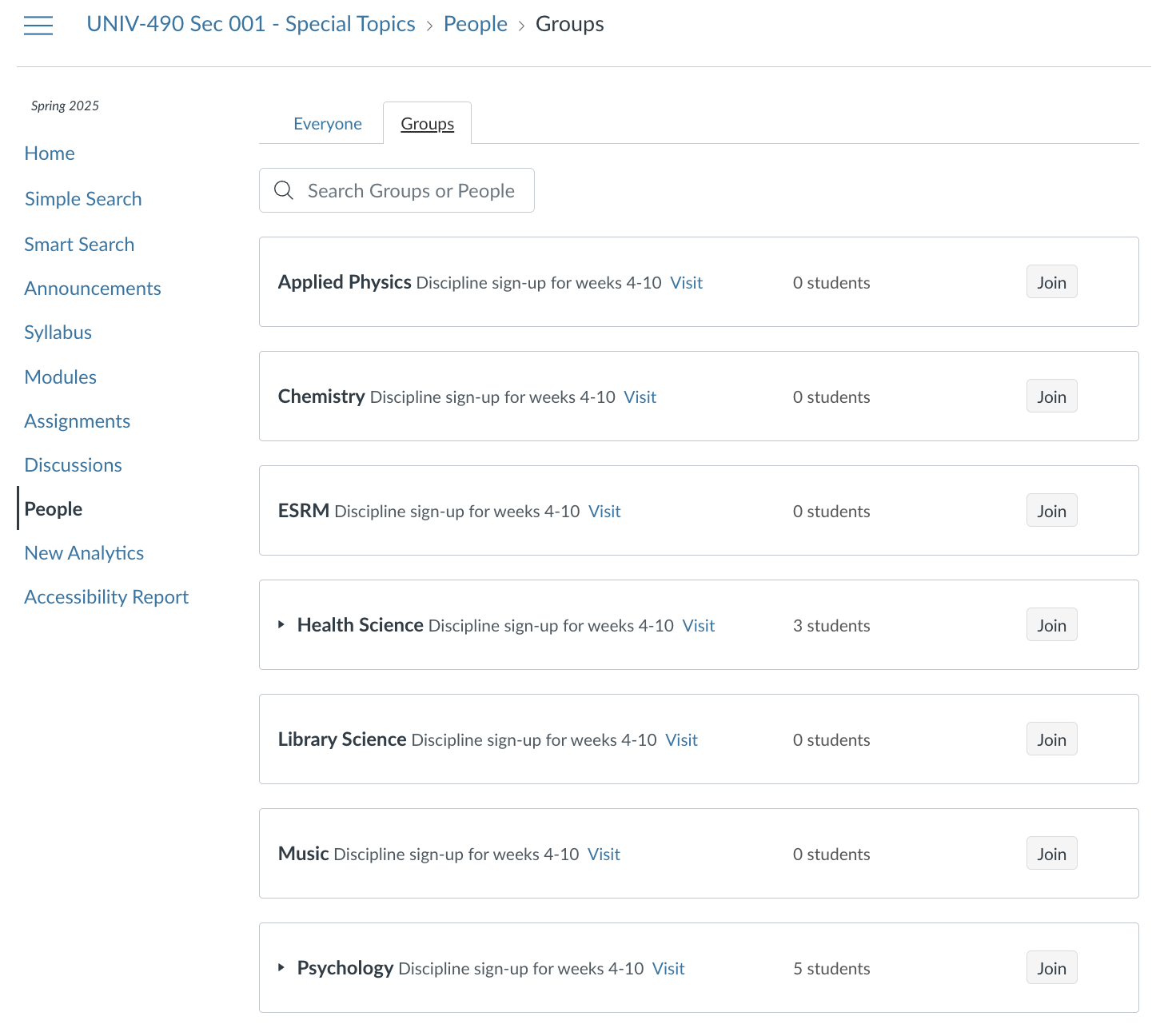
Discipline-specific groups so students could self-enroll ensuring they only see modules relevant to their chosen interest.
At the start of week four, the TLi team went in and added students to the section of the discipline that they signed up for. The discipline-specific modules were only assigned to the discipline’s section of the course. So, when a student signed up for Chemistry, for example, they were added to the Chemistry section of the course and only saw the Chemistry modules for weeks 4-10. This workflow made it so that students would only see 15 weeks worth of modules and assignments as opposed to the full list of over 64. It also ensured that the students’ to-do lists in Canvas only showed assignments specific to the discipline that they signed up for.
This system also benefits the course’s instructor because the grading can be filtered by section, and scores can only be entered for assignments that students are responsible for completing, instead of manually excusing students from assignments they aren’t intended to complete.
Interested in More? Call for Enrollment in Fall 2025’s Offering of UNIV-490
This University of California Office of the President-funded project required teamwork from a group of dedicated faculty introducing students to research in their fields, faculty and staff in the Library and WMC carefully creating student support modules, and the Teaching & Learning Innovations team for creative problem-solving related to course design; all efforts led by HyeSun Lee. As the Spring 2025 semester comes to a close and so does the first iteration of UNIV-490, the course will be offered again in Fall 2025, providing a safe place for CI students of all backgrounds to begin exploring research.
Brief Course Description
UNIV-490 Special Topics: This 16-week asynchronous course is recommended for students interested in research but unsure where to start. It covers foundational topics in undergraduate research and academic writing (8 weeks), followed by discipline-specific research skills and practices (7 weeks). For More Information, Contact Dr. HyeSun Lee: hyesun.lee@csuci.edu.
References
Branchaw, J. L., Butz, A. R., Smith, A. R. (2020). Entering research: A curriculum to support undergraduate and graduate research trainees. W. H. Freeman & Company.
Hudley, A. H. C., Dickter, C. L., & Franz, H. A. (2017). The indispensable guide to undergraduate research: Success in and beyond college. Teachers College Press.
Mieg, H. A., Ambos, E., Brew, A., Galli, D., & Lehmann, J. (Eds.). (2022). The Cambridge handbook of undergraduate research. Cambridge University Press.
