Motivations
As I began my role as an assistant professor at CSUCI in Fall 2023, I introduced a “get-to-know-you” questionnaire as the first assignment. This questionnaire invites students to share their motivations for enrolling in the course, along with details about their academic and personal backgrounds, any concerns, and questions they may have for me. After reviewing their responses, I provide each student with around 150 words of personalized feedback, which includes a welcoming message and words of encouragement. Initially, my intent was simply to understand the student population at CSUCI better, enabling me to support each student more effectively, but I found that this feedback fostered a strong rapport between us. As a result, I continue to use this assignment as an essential first step in building meaningful connections with my students.
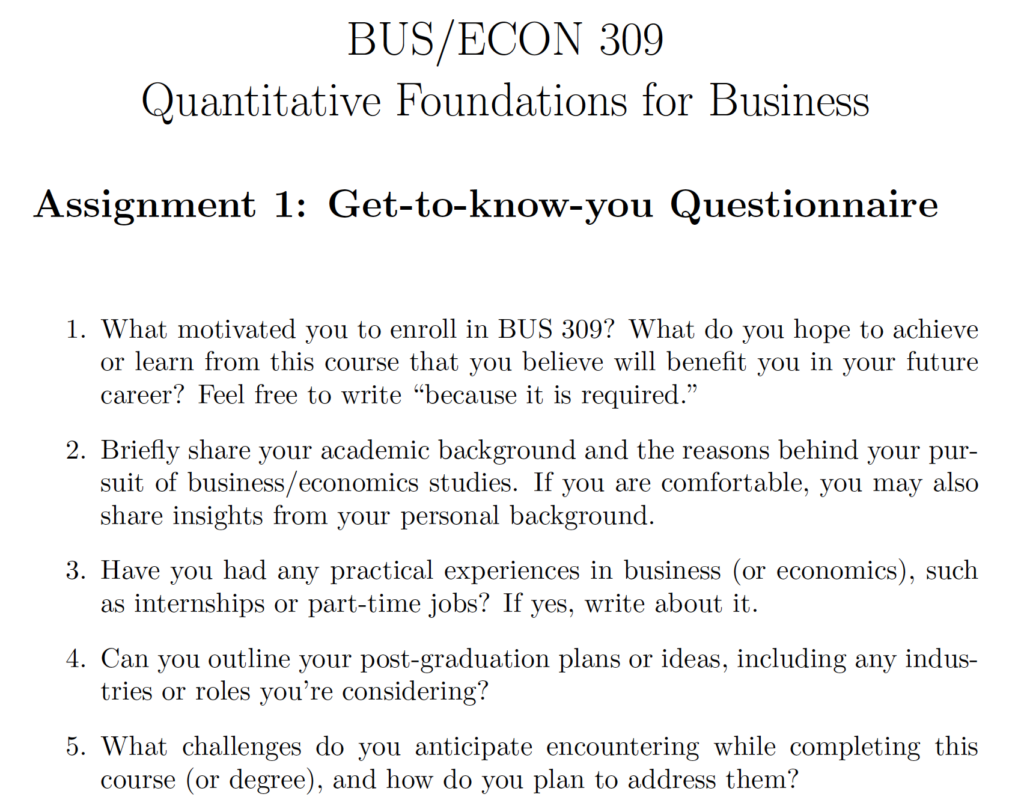
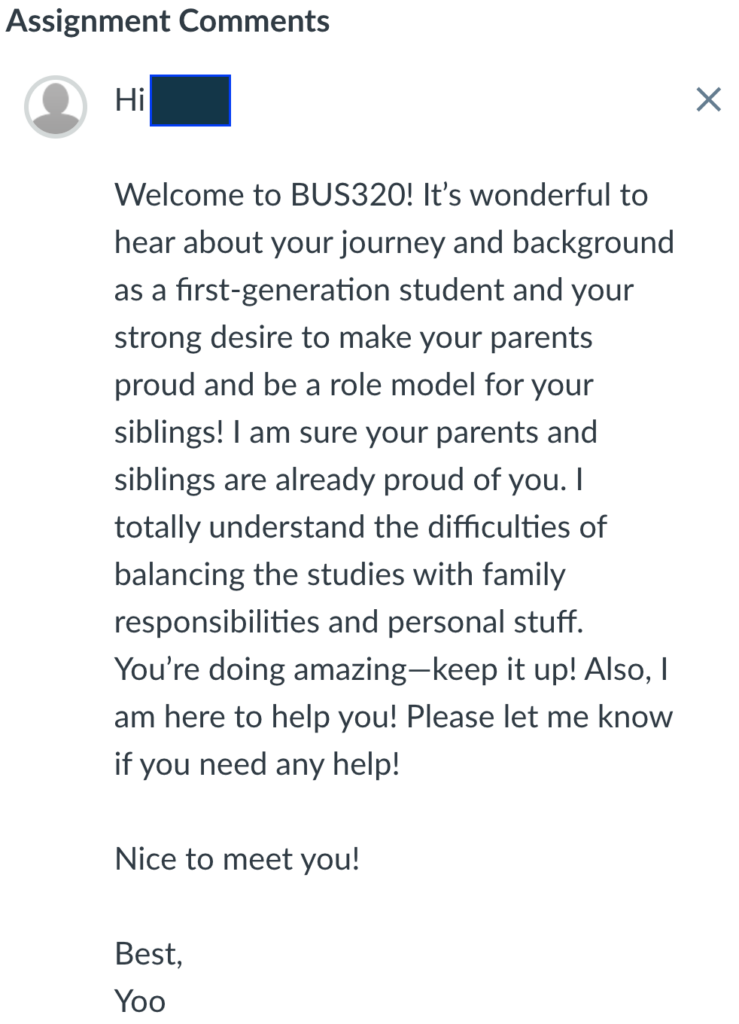
Why Feedback Matters
Existing literature supports what I’ve experienced in my own teaching: personalized feedback increases student engagement and motivation throughout a course. Iraj et al. (2020) discovered that early engagement with the feedback brought a higher probability of success in the course. Wang & Lehman (2021) found that providing feedback based on students’ goals and characteristics can help increase student motivation and self-regulation. These findings align with my belief that personalized feedback plays a significant role in student success and retention.
Can I leverage Generative AI for Feedback?
While personalized feedback is incredibly valuable, it can also be demanding. Writing personalized feedback for over 100 students can take anywhere from 5 to 10 minutes per response—totaling more than 13 hours of work. This led me to ask: Could generative AI help streamline this process? I believe that leveraging AI to assist with feedback could save time, allowing me to focus on other aspects of teaching while still offering students the personalized encouragement they need. That’s why I’ve started developing an AI-driven feedback system, which I hope will provide a more efficient way to manage this task without sacrificing the quality or personal touch of the feedback.
Research Questions
I’m aiming to answer the following research questions:
- How can I automate the process of providing personalized feedback to students while ensuring that the feedback remains supportive and tailored to individual student needs?
- Can we integrate this automated system into Canvas to enhance access for users without programming backgrounds?
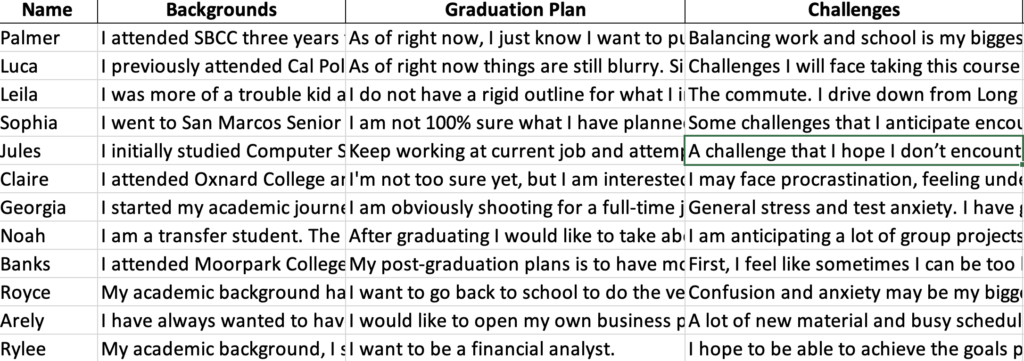
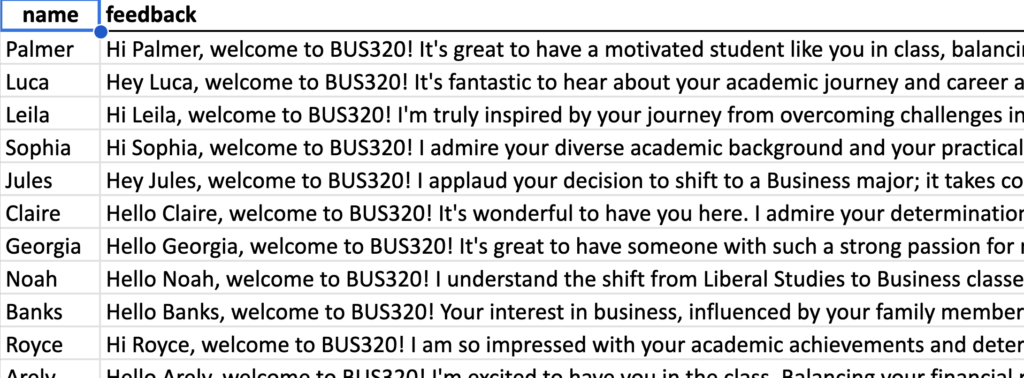
With the automated system I envision, I want to make the process as simple as possible, and I want this to be used by anyone, even people with zero programming background. Ideally, instructors would be able to download all students’ responses in an Excel file, upload that file into the program, and have the AI generate personalized feedback for each student. The feedback would then be saved directly into the file and ready to be uploaded to Canvas. I don’t even want users to have to copy and paste each comment into Canvas. Ideally, once they upload the file back to Canvas, the feedback would automatically be imported directly into the comment box for each student. That way, the entire process would be seamless, efficient, and user-friendly for any instructor.
Prototype
The following is the overview of the current prototype of the automated feedback system.
Step One: Read the data (see Figure 3 for the toy dataset) in Python
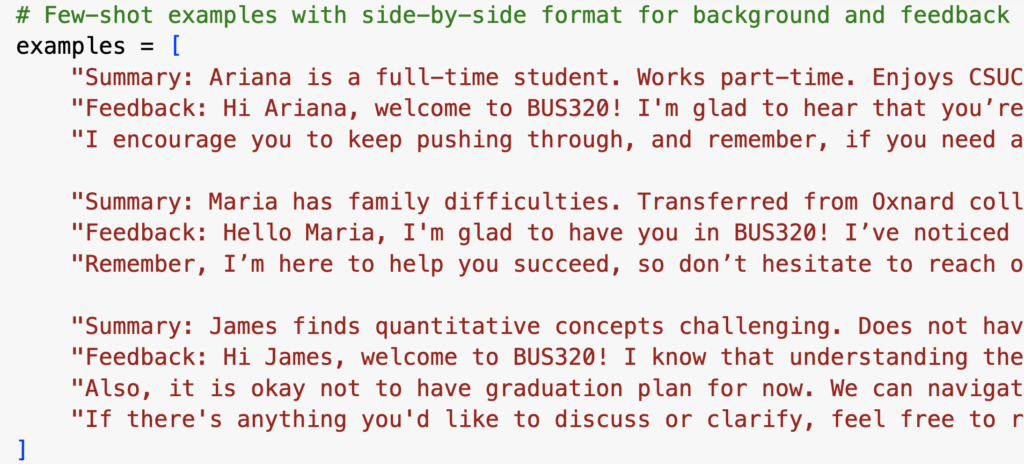
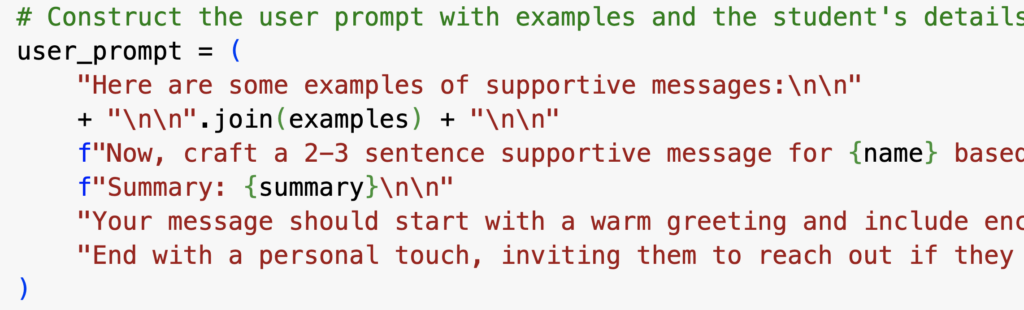
Step Two: Use GPT-3.5-turbo with few-shot prompting to generate personalized feedback
The feedback is based on students’ backgrounds, challenges, and graduation plans (which are saved in summary) (see Figures 4, 5, and 6 below for few-shot prompting).

Step Three: Save the generated feedback to the Excel file
Wrapping Up
I would like to conclude this blog post with a question: Could an automated feedback system fully replace my work in reviewing students’ assignments and leaving feedback? The answer is no. While I’m developing a generative AI-driven feedback tool, it will not—and should not—replace the personal process of understanding each student’s background. The purpose of the questionnaire is to genuinely connect with my students and support their learning journey. Relying solely on AI-generated feedback risks losing that connection, and AI may sometimes miss the nuances unique to each student’s experience. Thoughtful validation remains essential to ensure that the feedback truly resonates and aligns with each student’s individual needs. Lastly, this work is still in the prototype/experimental stage, and I am continuing to refine it so that it can be used more broadly in the future.
